
The good news is that it’s now easier to get an amateur radio licence than ever before! Years ago, anyone interested in becoming a radio amateur was required to take complex tests involving electronics theory, radio construction and in most cases, learn Morse code.
Things have changed here in the UK, making it considerably easier for newcomers to get started in the amateur radio hobby. You can now become a ham in just a few weeks by getting the entry-level Foundation Licence – you don’t even need to leave home!
On this page, we explain more about getting on-air with a ham radio Foundation Licence.
The Foundation Licence?
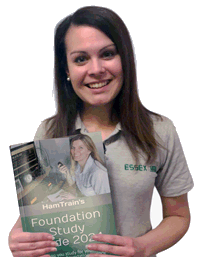 The Foundation Licence is an introductory licence to encourage new amateur radio operators to get a taste of the hobby, and to get on-air. As a Foundation licence holder, you’ll have access to a range of different frequencies, and if you enjoy the hobby, may want to progress to the Intermediate and Full licences.
Getting a Foundation Licence will allow you to transmit on the VHF / UHF and HF bands up to a power of up to 25 watts, which with a modest aerial and radio will be enough to get your radio signals into much of Europe and beyond.
One of the easiest ways to get a licence is to use our free online training course. This teaches you all you need to know, with videos, printable revision aids and loads of quizzes. Find out more here: Essex Ham’s Foundation Online course. Alternatively, you can study at one of the many ham radio clubs across the UK.
If you’re considering taking your exam, you may also want to check out the Foundation Licence Manual– This low-priced 42-page A4 book explains all of the basics, contains handy bits of information for the newbie amateur, and tells you what you need to know to pass the exam. More: Paper version and Kindle version. (See also: Amateur Radio Books)
How to get started in amateur radioThese two videos explain a little more about the hobby, and how to get started by getting a Foundation licence: |
Foundation: Exam
To get your first amateur radio licence, you’re required to sit a 26-question multiple-choice exam. You have the option of home-study using a free online course such as our Foundation Online course, studying with the help of a local amateur radio club, self-study using the RSGB’s Foundation Manual, or with help from another licenced radio amateur.
The exam is pretty straightforward and covers the following categories:
- Amateur Radio and Licence Rules – 6 questions
- Technical Basics – 3 questions
- Transmitters & Receivers – 3 questions
- Feeders and Antennas – 3 questions
- Signal Propagation – 2 questions
- EMC (avoidance of interference) – 3 questions
- Operating Practices – 3 questions
- Safety – 3 questions
You have 60 minutes to answer the 26 questions, and if you’ve paid attention during the course, then the exam should present no problems at all. To pass, you’ll need to get 19 of the 26 questions correct (73%). For more, see Getting Started: Foundation Exam.
| Update: Study and pass online
From 2021 it became possible to take your exam online – no need to complete any practical assessments, or visit an approved exam venue. You can also study online for free (To enrol, visit Foundation Online Registration). If you prefer classroom-based teaching, many local clubs offer training courses and exams. |

Foundation Licence & Callsign
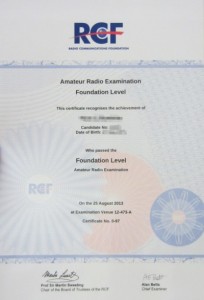
You normally get your results immediately after taking your exam. Assuming you pass, you’ll be sent a Pass certificate by post from the RSGB (Radio Society of Great Britain).
Your details will be passed on to the UK regulator, Ofcom, and you’ll be able to apply for your licence and callsign.
For details of how to do this, see: How to apply for your amateur radio licence
Your Foundation callsign will begin with “M7” followed by three letters, and you can pick those three letters yourself (if the callsign you’re after hasn’t been taken)
Once you have your callsign and your licence, you’re able to start transmitting on HF (long-distance) and VHF/UHF (shorter distances), and you can start to see where the hobby takes you.
Next Steps?
Hopefully, this page has given you a feel for the process and how to get started. If you are keen to get on and get your licence, it’s a case of studying for the exam.
 You can learn from taking an online course, reading the course book, or visiting a local amateur radio club. A good number of amateur radio clubs offer training courses and support.
If you want to study online, try our free Foundation Online course to help you study.
If you’d prefer to study at a club, put your address into the RSGB Club Finder to find your nearest one.
Related content
- Amateur Radio Online Training Course
- Foundation Licence Manual
- Online Amateur Radio Training Courses
- Training in Essex
- Got your licence? See our Just Got Your Licence page

Great info!
Thanks
Can you clear up something for me regarding the practicals for the Foundation? Would it be possible to take all of the practicals at the same time, or is that simply not logistically possible due to time constraints. I live an hour’s drive from the neares exam centre and I don’t fancy taking four separate trips to get the practicals out of the way before I’m allowed to take the technical exam.
All clubs operate differently, but there are some clubs that allow you to complete all of the practicals in one session. For example, in Essex, the Colchester club runs a one-day “fast track” course that includes all practicals, plus the exam, in a single day.
Pete
Pete, I am on temporary assignment here in the US but home is the UK. I would like to take the foundation online test but not sure about doing the practical. I have obtained the Amateur Extra to operate here in the US. I travel back a couple times a years for a week then back to the US. Hoping I get into the September Foundation course. I haven’t heard back if I got a spot.
Hi ,
Hoping to get foundation licence soon
But as covid restrictions are making tests online
Do I still need to sit practical test and if so how
Thank you .
Practicals are suspended due to Covid. All you need to do is sit a 26 question multiple choice exam online. Pete
Hi i live in Nottingham and all the local clubs are running there next foundation courses in November.
Do you know off any course that do a weekend including exam.
I dont mind travelling
Kind regards phil
Hi Phil,
Try https://rsgb.org/main/clubs-training/course-exam-finder/ for a handy tool to show clubs offering training by distance.
Hope this helps,
Pete
I passed the old time ham examination, City and Guilds of London Institute.
I stopped being ham time ago. Now, I would like to get back with the hobby. Is the old examination result still valid or I need to re-take the present examination again?
Hi Simon no I passed the rae in 1989 no mose test applied for my license in 2019 and got mu full license hope this helps 73 Russell M0IWW
I’m need help to channel my ham radio 88s radio can you call me07561035860
Stupid question maybe but once you have passed the Foundation licence can you use your callsign abroad i.e. holiday in Europe with a 2m/70cm handheld? Or is the M7 callsign just restricted to the Uk?
M7 (Foundation) is UK-only
Ok thanks Pete great info…
my son wants to get in to ham , how old does he need to be to get a foundation licence
thanks for any help
As far as I know, there is no minimum page. I’m aware that someone as young as 8 has been able to get a Foundation licence.
Ok thanks for your help
I have a exam phobia which stems back to my school days 1977 to 1981. I’ve passed many exams since then (welder by trade CSCS card) I’m determined to pass this foundation test and the intermediate. But I’ll need some help. You’ll be hearing from me soon. My modified cobra 148 gtl DX is itching to get back on. Anyway I’ll be in touch. Thank you
What if you are dislextic
Help is available such as exam papers printed on coloured paper, large-print versions of exam papers, use of a “reader” during the exam or extra time to complete the exam, but you’d need to discuss this in advance with your exam centre – See https://www.essexham.co.uk/train/amateur-radio-and-dyslexia/
hi
I am trying to get on list for 5/4/2020
butn don’t think its letting me due to not having a call sign
thank you
You’re on the list for the April course John – not sure what you mean about the callsign though.
Hi sorry if this is a bit of a daft question? I was into CB radio in my youth, many years ago lol
Would love to get into ham radio, but have one question? This is the daft part
To take a foundation course, would I need a ham radio at home? Told you it was daft
Not a daft question. No, you don’t need any amateur radio equipment to get your licence.
Pete
Hi all,
Very grateful for all the effort that goes into this site, the foundation course and the actual club. Most impressive is the fact you offer it free to anyone. I suspect there are loads of people like myself who just don’t fancy / don’t have the time to be part of a physical club. To us you have made starting out on this journey so much easier. Please keep up the good work and I hope in future you’ll look to offer the more advanced exams in similar formats. Enjoy the coffees, they are well earned.
How long does the foundation licence last for before having to take the intermediate test. I read a news letter on RSGB website around 6 months ago stating they are in talks with ofcom,saying that if a foundation licence holder has not moved up to an intermediate licence holder within 2 years then they will revoke their licence and will have to take a re-test. Is this true its not very good, some people may not want to progress any further. Any info will be great, thanks.
Hi Jim,
That was an idea being discussed a few years ago as part of a licence review. There are no such plans in place or planned as far as I know.
Pete
Pete, I am on temporary assignment here in the US but home is the UK. I would like to take the foundation online test but not sure about doing the practical. I have obtained the Amateur Extra to operate here in the US. I travel back a couple times a years for a week then back to the US. Hoping I get into the September Foundation course. I haven’t heard back if I got a spot.
Hi Pete and all, just passed the Foundation Licence exam after doing your fast track course. Thanks Again
Chris Adams
Your website is excellent. Full of good information and training links. It is also pretty much the first URL that comes up on google!
Thank you for maintaining and doing the online training. Can’t wait for the online training to start :)
I didn’t understand why people were so negative towards the youtuibe examples of the exam. It’s just like a Health & Safety video at work, so there’s nothing wrong with it. There will always be some people who complain about everything…
After passing the foundation licence how would an amateur progress to using over 10w on all bands? Is a morse exam still required?
Hi Ian. After Foundation comes Intermediate (which offers up to 50 watts). During Covid, it’s an online exam (no Morse required)
Just passed the foundation exam today using the fast track course – everything and more you need to know and very easy to take in. Many thanks!
hi pete i read all brilliant info , i start the course 5th dec thank you and all concerned
Dear radio amateurs! We in Ukraine need support for a collective radio station to counter Russian propaganda on shortwave radio. We need a transceiver, even an old one, We need help, we hope for your understanding in confronting Russian aggression.
I took my ham exams with city & guilds back in 1994 I have the certificate. Can i apply for a licence.
Yes you can. There’s an application form on the Ofcom website. Send a copy of your pass certificate with your application, and they should be able to sort you out with a licence.
A true service you have offered here with your rich content. Thank you. Really outstanding !
Are practical exams now back on the table in 2023 or can one still get the foundation license with an online exam only ?
There are no longer any practical sessions as part of the exam. You can take the exam online or at a local club.
iv read about taking this course through you, the problem i have im not that good navigating with a computer so have decided to take the foundation course at my local club instead sorry for any inconvenience.