

We’re being told to “Be Ready” and stock up on food and water. But would you be ready if your phone and broadband went down?
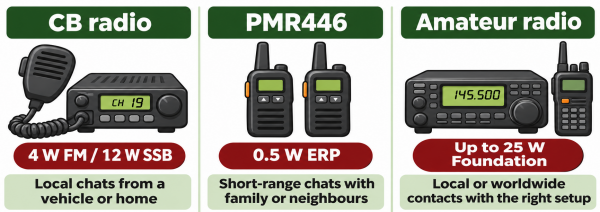
Could owning a low-cost radio make sense? CB radio and PMR446 radios might be an answer (see full article), but amateur, or ham, radio offers the greatest flexibility for local, national and international communications if the networks are down.
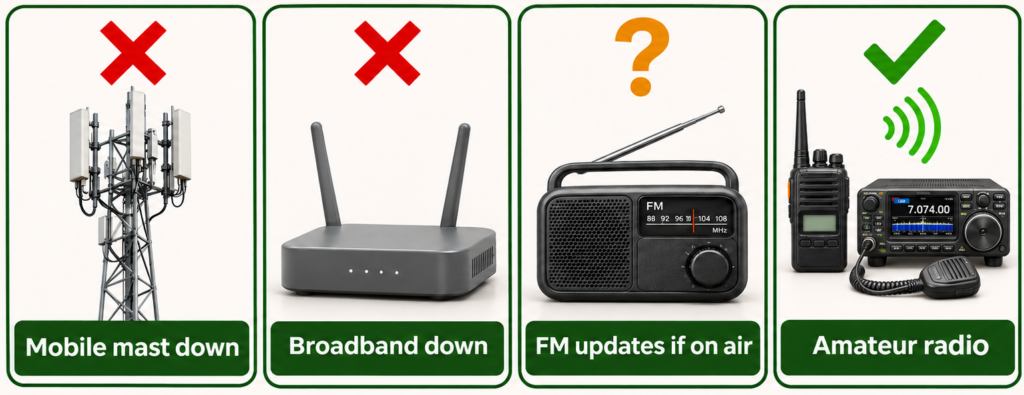
Which radio would help you?
The UK Government’s Be Ready campaign suggests keeping a battery-powered or wind-up radio at home. It’s a useful way to hear news and official advice during a power cut, network outage or a cyber-related incident, provided a station is still broadcasting.
If you want to talk as well as listen, think about who’s at the other end. A pair of licence-free PMR446 walkie-talkies could be enough for a family or neighbours a few streets apart, but buildings and hills affect range, and the power is limited. CB offers more power, but still has its limits. Amateur radio offers the most flexibility, with higher power, wider range and an active UK community. (See full article)
With an amateur radio licence, a handheld can get you talking to other licensed amateurs nearby. A home station with a suitable aerial opens up contacts further afield, and with HF, round the world comms is possible – no mains power, no subscription. As was demonstrated during the Covid lockdown, the UK amateur radio community is there to help when it’s needed.
Getting started
Until CB and PMR446, there’s a short online exam… but don’t let that put you off. Yes, there’s a little theory to learn, but for a few hours of study, you’ll understand frequencies, transmitters and antennas – a handy life skill if you need to make comms work. The exam is there because of the power and frequencies you can access.
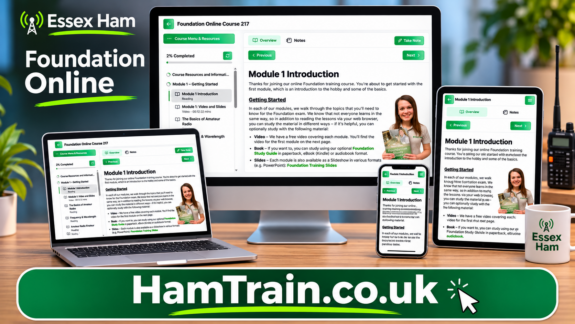
Essex Ham offers a free training course. More than 16,000 people have studied with us, and counting. Our online course takes you through the basics in plain English, with short lessons, videos and quizzes. You’ll learn how to choose a radio, what makes a difference to its range and what to say when you press the transmit button for the first time.
The course is free. The Foundation exam costs £35.50 after which you get a free lifetime licence from Ofcom. You can take it online from home. There are 26 multiple-choice questions, and you need 19 correct answers to pass. Once you’ve passed, you can apply for your free Ofcom amateur radio licence and get your own callsign.
Ready to give it a go? Join Essex Ham’s free Foundation Online course or try a Foundation mock exam to see what the questions are like.
- Be Ready: How to Stay in Touch During an Outage
- Are wind-up radios a wind-up?
