In the run-up to the global commemoration of the 50th anniversary of the lunar landing in 1969, we were contacted by David Whitehouse, author of Apollo 11 – The Inside Story, with an interesting challenge.
David is a former Science Consultant for the BBC and has written several space-related books – he’s even had an asteroid named after him. His request was to see if he could use amateur radio to send a message to the Moon.
During our initial discussions, we talked about amateur radio, ARISS contacts with the Space Station, amateur satellites and, of course, moonbounce. Unsurprisingly, moonbounce was what interested David the most, so that became the mission.
We’re fortunate in Essex to have Tom M0ABA from the Essex DX Group as something of a local expert on moonbounce. He’s previously made numerous successful contacts, including what we believe to be the first M6 callsign to make it to the Moon and back (see: 10 watt moonbounce success), so we made contact to see if Tom could help.
Tom came up trumps, looked into the optimal lunar time and worked out that 27 July would be the best date closest to the Apollo 11 mission anniversary, as the Moon was starting to close its distance on Earth after being at apogee – its farthest point from Earth. With the date in mind, preparations began.
27 July Moonbounce
The optimal time for the attempt meant an early start for Tom M0ABA in Essex, but also for Bernd DL7APV, a German moonbounce specialist whom Tom contacted to help with receiving and confirming the QSO.
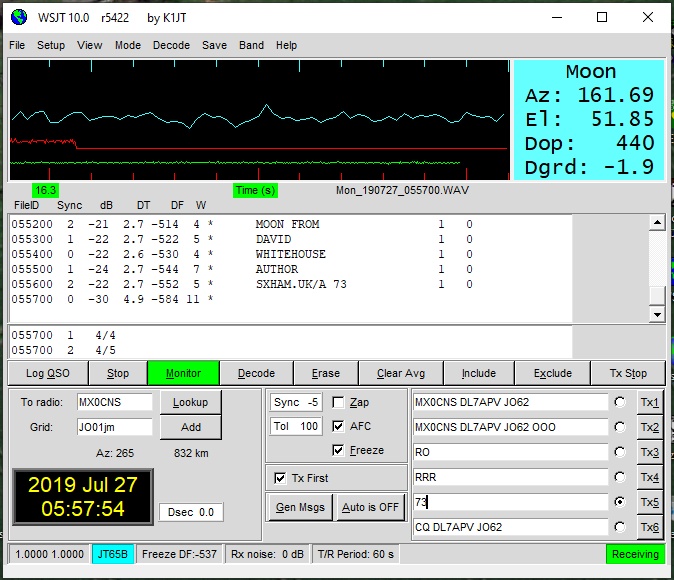
The message was sent using WSJT-X in JT65B mode. Those familiar with JT modes will be aware of the restriction on the number of characters that can be sent in a single transmission. It just wasn’t practical to send freeform text such as “Greetings to the Moon from David Whitehouse” as a single message via JT65B, so the greeting was split into chunks and included the full message via an Essex Ham short URL.
In the UK, the signal was sent using a Yaesu FT-857D into a Microwave Modules SSPA (Solid State Power Amplifier), running 60 watts into a home-made DG7YBN GTV 70-17 antenna, with a standard Microset preamp at the antenna.
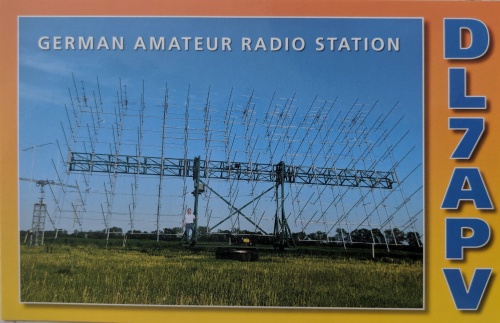
In Germany, Bernd DL7APV was listening with his 128 x 11 GTV Yagi array.
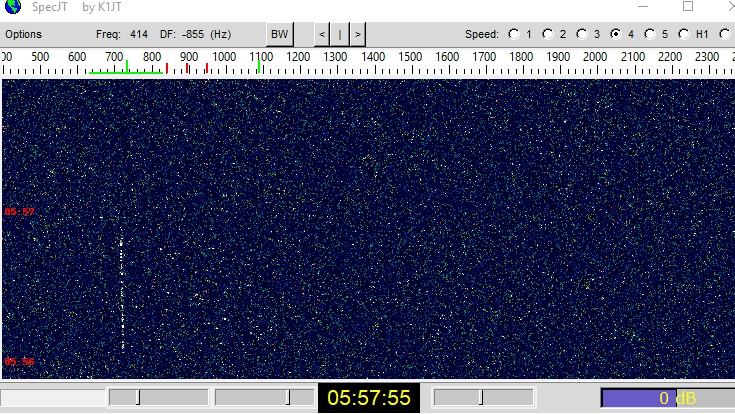
The Moon was at a distance of around 384,000km for the greeting message and, despite signal degradation on the path to the Moon and back hampering the QSO, as well as Faraday rotation causing deep fades, the full message was successfully received and decoded – via the Moon – in Germany at 0557 GMT.
Here are the screenshots from Bernd’s station in Germany:
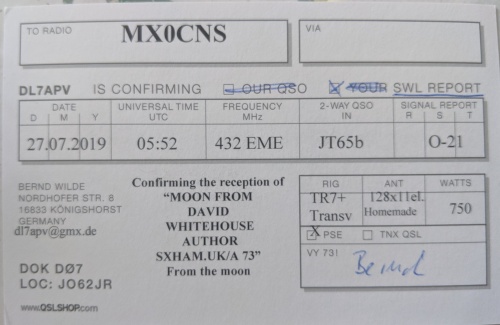
Update: Tom has now received a QSL card from Bernd, which Tom arranged to send on to David Whitehouse to commemorate David’s ‘trip’ to the Moon.
Bernd DL7APV QSL Card | Bernd DL7APV QSL Card
Well done to both Tom M0ABA and Bernd DL7APV for making this happen. Not only did this event help to make David Whitehouse’s wish to reach the Moon become a reality, it also highlighted amateur radio in action.
Thanks also to Richard G7OED and Dorothy M0LMR for their support of the event.
GB5AML
To commemorate the 50th anniversary of the lunar landing, Essex Ham used the special event callsign GB5AML – Apollo Moon Landing – between 20 and 28 July, running two field days at Galleywood Common.
[ngg src=”galleries” ids=”115″ display=”basic_thumbnail”]
Apollo 11 – The Inside Story
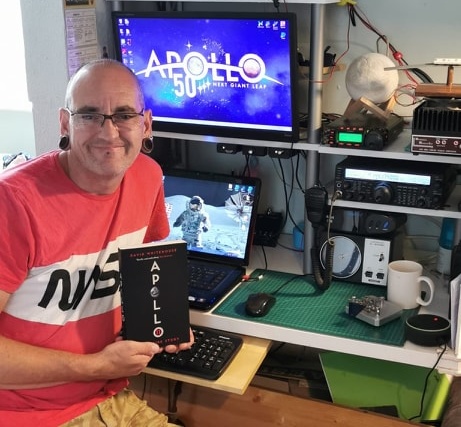
As an aside, if you’re interested in the Apollo missions, David’s book is well worth a read. He kindly provided us with a few copies.
It’s a great read, with a good selection of photos in the middle of the book. I’ve read a couple of Apollo books in the past, including Andrew Chaikin’s A Man on the Moon and Gene Kranz’s Failure Is Not an Option, and David’s book contains numerous insights that I’d not come across before.
It’s very readable and covers the entire Apollo era, with some great astronaut interviews. Well worth getting hold of a copy: Apollo 11 – The Inside Story (Amazon).