
Think you can’t use amateur radio where you live? Think again – there are plenty of options, even if you live in a flat, have a tiny garden, can’t put an antenna on the roof or simply don’t want a large aerial upsetting the neighbours.
One of the great things about amateur radio is that you don’t need a tower and a huge beam antenna to get on the air. With a little imagination, it’s possible to operate from surprisingly restricted locations.
Why can’t you operate where you live?
Here are some of the commonly-cited reasons:
- Unable to put up an antenna because of planning restrictions
- Living in rented accommodation where the landlord won’t allow a permanent antenna
- Living in a flat with no garden
- Having a very small garden
- Being too far away from a local repeater
- Not wanting to upset the neighbours
- Not wanting an unattractive antenna in the garden
- Living somewhere with a lot of electrical interference
None of these necessarily means you can’t enjoy amateur radio.
Not allowed a permanent antenna?
It may be that you’re in a flat, don’t have a garden, rent your home or have restrictions about attaching antennas to the roof or walls.
There may still be several possibilities:
- An indoor antenna
- A loft antenna
- A temporary antenna that’s only put up when you’re operating
- A portable antenna
- A discreet or “stealth” antenna
- Operating away from home altogether
Don’t assume that making an antenna temporary or difficult to see automatically avoids planning, tenancy or property restrictions. The rules depend on the installation and where you live, and tenants should normally check their tenancy conditions or obtain permission from their landlord.
If you’re considering a substantial external antenna or mast, the RSGB Planning FAQ is a useful starting point.
Indoor and loft antennas
If you can’t put an antenna outside, an indoor antenna may still get you on the air.
For VHF and UHF, height is particularly important, so an antenna in an upstairs room or loft can work considerably better than a handheld antenna downstairs.
A loft-mounted 2m/70cm vertical, Slim Jim or small beam can sometimes work very well.
The downside is that roof tiles, foil-backed insulation and other building materials can attenuate radio signals. Modern insulation containing metal foil can be particularly troublesome.
Indoor antennas can also be closer to computers, televisions, LED lighting, power supplies and other sources of electrical interference.
Even so, if the alternative is no antenna at all, it’s certainly worth experimenting.
A simple temporary VHF/UHF antenna
For VHF and UHF, a rooftop antenna is usually ideal, but it’s not always practical.
The solution can be something that goes up only when you want to operate.
I’ve successfully used the two arrangements shown below.
The first uses a mobile antenna mounted on a short piece of plastic plumbing pipe. This can be temporarily secured to a balcony, fence or other suitable support, or attached to a piece of wood and positioned outside a window while operating.
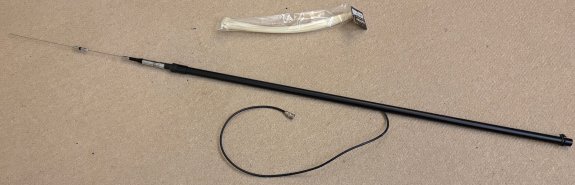
2m/70cm mobile antenna mounted on a temporary pole
The second is a home-made Slim Jim antenna.
A lightweight Slim Jim can be:
- Attached to a fibreglass fishing pole
- Hung from a balcony
- Suspended from an upstairs window
- Hung in a loft
- Used indoors from a curtain rail
They’re inexpensive, easy to make and a significant improvement over the small rubber antenna supplied with many handheld radios.
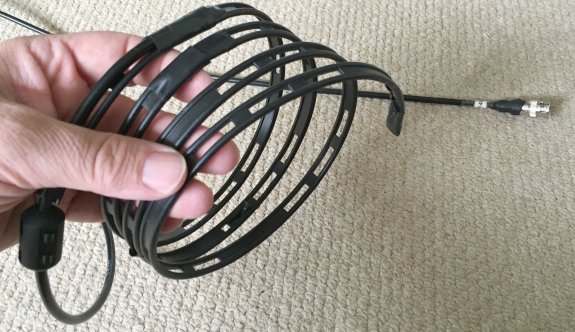
A simple 2m Slim Jim antenna
Stealth antennas
If the main problem is appearance, there are plenty of ways of making an antenna much less noticeable.
This is particularly true on HF, where an antenna can often be made from thin wire that’s surprisingly difficult to see from a distance.
Possible supports or hiding places include:
- Along a wooden fence
- Between trees
- Along the edge of a roof
- Around a garden boundary
- Behind guttering or other structures
- Inside a loft
- As part of a washing-line arrangement
- Supported by a discreet fibreglass pole
My first stealth HF antenna was simply a length of wire running along the garden fence. It was almost invisible to neighbours, yet I was still able to make HF contacts around the world.
That’s worth remembering: an antenna doesn’t have to look impressive to work.
Stealth antennas for HF
HF can actually be surprisingly suitable for restricted locations.
You don’t necessarily need a large tower or beam antenna. Depending on your space, possibilities include:
- End-fed wire antennas
- Dipoles bent to fit the available space
- Loops
- Vertical antennas
- Temporary wire antennas
- Portable antennas erected only when in use
There are compromises with all small or restricted antennas, but compromise antennas can still make plenty of contacts.
One thing to be aware of is that some end-fed antennas can be more prone to RF and interference problems if they’re poorly installed, so antenna matching, positioning and common-mode control matter.
|
Stealth Antennas is a useful book for anyone dealing with small gardens, planning problems, neighbours or flats.
Written by antenna specialist Steve Nichols G0KYA, it covers roof and loft antennas, low-profile installations and genuinely discreet external antennas, with practical examples of what other amateurs have achieved. Available here: |
 |
What if you’re worried about upsetting the neighbours?
A large visible antenna can sometimes attract attention before you’ve even transmitted.
If neighbour relations are a concern, keeping the installation neat and explaining what amateur radio is can often help.
Interference is a separate issue. A properly-installed amateur radio station shouldn’t automatically cause problems with televisions, radios or other equipment, but EMC problems can occasionally occur and need to be investigated properly.
If you experience interference problems, don’t immediately assume that either your radio or the neighbour’s equipment is at fault. Finding the actual cause is important.
The RSGB has useful EMC information and advice.
No antenna at home at all? Go portable
If operating from home isn’t practical, take the station somewhere else.
Portable amateur radio has become a major part of the hobby and can be as simple as taking a handheld to a local hill or as involved as setting up a complete HF station in the countryside.
Possible locations include:
- A local park
- The countryside
- A hilltop
- A beach or seafront
- A campsite
- A friend’s garden
Being away from houses can have another major advantage: the radio noise level may be dramatically lower than it is at home.
Parks on the Air – POTA
Parks on the Air (POTA) encourages amateurs to operate portable from qualifying parks and similar locations.
You can become an activator by taking your station to a qualifying park, or a hunter by contacting activators from elsewhere.
It can be an excellent option for someone who doesn’t have room for an HF antenna at home.
Summits On The Air – SOTA
If hills are more your thing, there’s Summits On The Air (SOTA).
SOTA encourages portable operation from qualifying hills and mountains. A lightweight radio, battery and wire antenna can provide a surprisingly effective HF station from a good location.
We’ve got a separate beginner’s guide here:
Operating from the car
Another option is mobile operation.
You can start simply with a handheld and an external magnetic-mount antenna on the car, or install a dedicated VHF/UHF mobile radio.
For HF, some amateurs also install mobile HF antennas, although these tend to be more of a compromise because of the much longer wavelengths involved.
A vehicle also gives you the freedom to drive to a better radio location. Sometimes moving only a few miles to higher ground can completely transform VHF and UHF reception.
What if you can’t reach a repeater?
Being unable to reach your nearest repeater doesn’t mean amateur radio isn’t practical from your home.
You could:
- Try a better or higher VHF/UHF antenna
- Use simplex and make direct contacts
- Try another repeater
- Operate portable from a better location
- Explore HF
- Try digital voice with a personal hotspot
- Use EchoLink
Repeaters are useful, but they’re only one small part of amateur radio.
Using EchoLink with no external antenna
If you genuinely can’t install any kind of useful antenna, EchoLink is another possibility.
EchoLink allows licensed amateur radio operators to communicate with other amateur stations over the Internet.
You can use it from Windows, Android, iOS or directly from a compatible web browser, so you don’t necessarily need any radio equipment at home at all.
You still need to hold a valid amateur radio licence and have your callsign validated before using the system.
Read our EchoLink beginner’s guide »
Digital voice hotspots
If you’d rather use an actual handheld radio, another option is a digital voice hotspot.
A small hotspot connects to your Internet connection, and your handheld talks to the hotspot over a short-range radio link.
Depending on the hotspot and radio, systems can include:
- DMR
- D-Star
- Yaesu System Fusion
This lets you use a handheld from inside the house even if you can’t reach a suitable digital repeater.
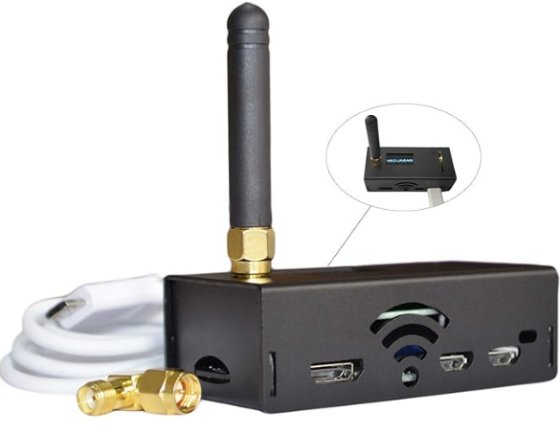
See amateur radio digital hotspots »
Receive-only options
Don’t overlook listening either.
If transmitting from home is difficult, you can still explore large parts of the radio spectrum with:
- A traditional communications receiver
- A scanner
- A low-cost SDR receiver
- WebSDR and remote receivers
A small SDR dongle and a modest indoor antenna can provide hours of experimentation without needing to transmit anything.
Safety with temporary antennas
Temporary doesn’t mean risk-free.
Be particularly careful when using poles, fishing poles, ladders or long pieces of wire outdoors.
Never erect an antenna where it could come into contact with overhead power lines.
Also make sure that a temporary mast or antenna can’t fall onto people, roads, neighbouring property or electrical cables.
Don’t let your home stop you enjoying amateur radio
The key point is that a conventional home station isn’t the only way to enjoy the hobby.
If you can’t put a large antenna on the roof, try a loft antenna.
If you can’t use the loft, try something temporary.
If you have no garden, go portable.
If you can’t reach a repeater, try simplex, HF or a better location.
If you can’t use an external antenna at all, explore EchoLink or digital voice hotspots.
There’s almost always another option.
Hopefully this page has given you a few ideas to experiment with. Good DX and 73!
Pete M0PSX
Some of the links on this page may link to external sites offering affiliate payments for referrals. These help to continue to fund our website.
Comments or suggestions?
Have you managed to get on the air from a flat, rented property or particularly difficult location? Add a comment below, or share your experiences in our forum.