

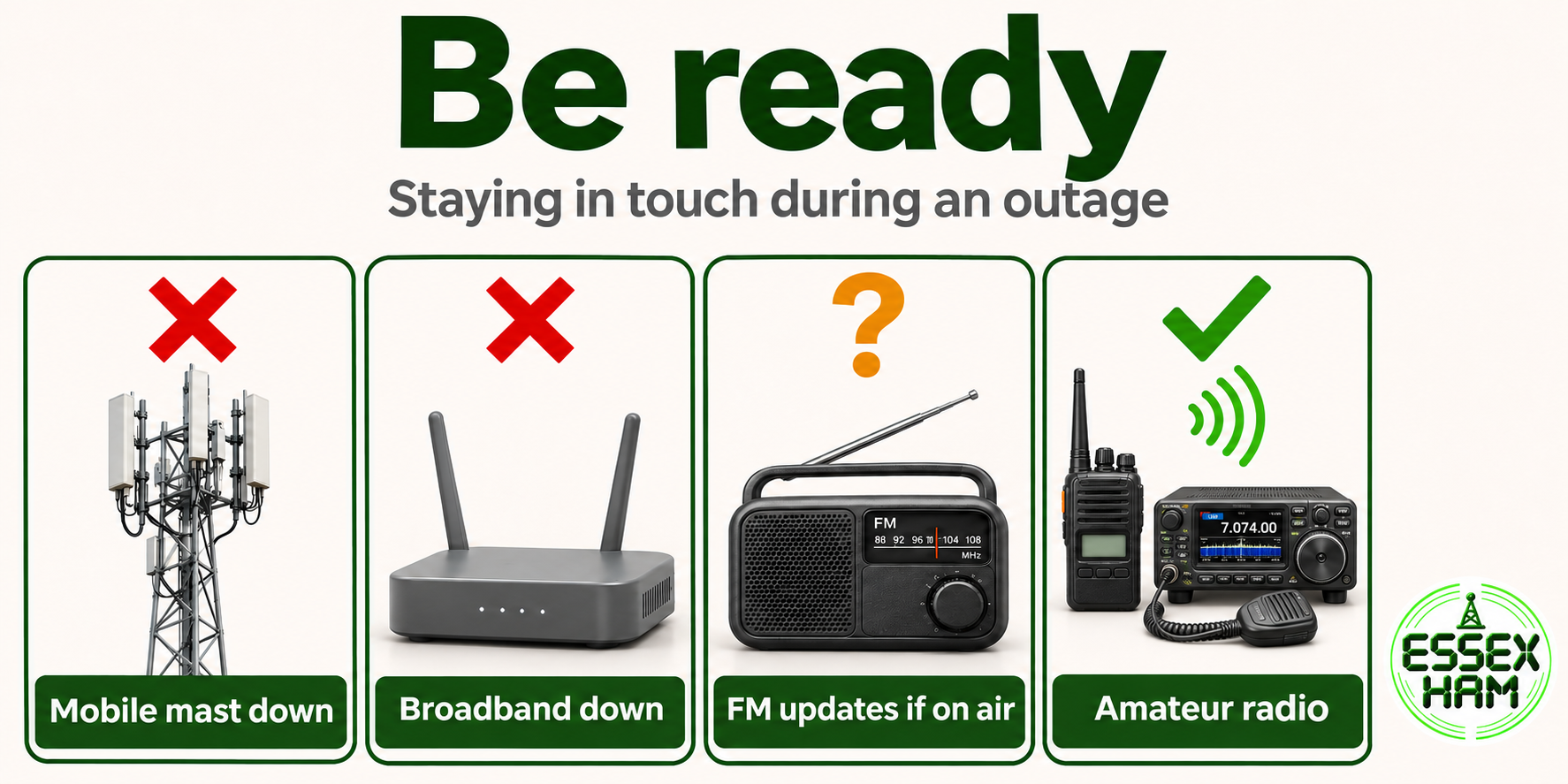
How would you stay in touch if the power, broadband or mobile network went down? Recent outages have put that question back in the spotlight. The UK Government’s 2026 Be Ready campaign encourages households to prepare for up to three days of disruption, including keeping a battery-powered or wind-up radio for updates.
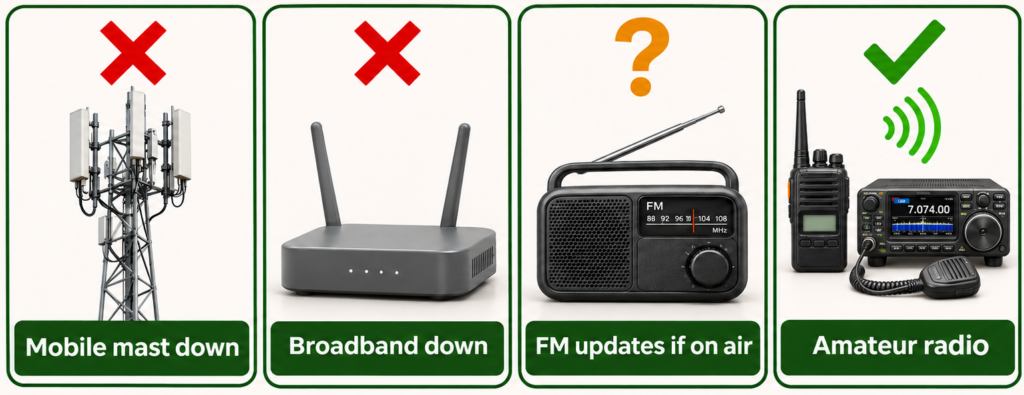
What works when the power, internet or mobile network goes down?
| Option | What to know |
|---|---|
| Traditional landline | A basic corded phone on an active analogue line can often work during a household power cut, BUT the UK is phasing out the old analogue phone network. Once your line moves to digital, the power requirements change. See below… |
| Phone over broadband | Usually needs mains power for your router. The wider service can still be disrupted by power loss, severe weather or a cyber incident. |
| Mobile phone | Sensible advice is to keep your phone charged and have a USB power bank handy. Calls and texts depend on a working mobile network. Phone masts rely on mains power, and power cuts, severe weather or wider network failures can affect coverage. Networks become unreliable under heavy load. |
| Email & Web | Email and web services need a working internet connection and a working service at the other end. The November 2026 Microsoft 365 outage showed how a provider fault can disrupt widely used tools. |
| Satellite phone | Can make calls beyond terrestrial coverage if you have a usable view of the sky. A UK retail example, the Iridium 9555, was listed at about £1,080 for the handset, with airtime extra. Some modern smartphones can make an SOS over satellite, which may be worth exploring. |
| Battery or wind-up FM radio | Useful for listening to news and official advice. It’s receive-only and depends on a station still broadcasting. FM transmitters need power, and the amount of genuinely local information you’ll hear varies by area and station. |
| Personal two-way radio | Battery-powered radios can talk directly without a SIM, subscription, broadband connection or mobile mast. You’ll need someone with a compatible radio within range, a channel or frequency you’ve agreed in advance, and charged batteries. |
A useful starting point: keep a radio for listening to updates and agree how you’ll contact the people you’d actually need to reach. Try that plan before you need it. In an emergency, use 999 or 112 if you can get through. Two-way radios give you another way to contact people within reach, but aren’t a replacement for the phone network or for contacting the emergency services.
CB, PMR446, business radio or amateur radio?
| Radio type | Typical cost and licence | Frequencies and power | What it’s good for |
|---|---|---|---|
| CB radio | Handhelds from about £80. In-car and base-station options are available. Licence-exempt. No exam. | 27 MHz. Two sets of 40 channels in the UK. Up to 4 W on FM and double-sideband AM, or 12 W peak on permitted single-sideband channels. | Licence-free, but with limits. Useful for local contacts, especially with a decent aerial. At 27 MHz, an efficient aerial is relatively large. A compact handheld aerial is a compromise. Online groups can help you find active users. |
| PMR446 walkie-talkies | Basic pairs from about £25–£30. Licence-exempt. No exam. | 446 MHz. Typically 16 analogue channels, up to 0.5 W ERP, with a fixed aerial on a handheld radio. | Low-cost option for short distances. A simple way for family or neighbours to keep in touch over short distances. Buildings and terrain can cut range sharply. Limited to the radio’s fixed antenna. |
| Ofcom Simple UK Light business radio | Budget handhelds can cost around £25 each. Check that the equipment is suitable before buying. The licence costs £75 for five years. No exam. | 19 shared frequencies across four VHF and UHF business radio bands. Up to 5 W ERP. Portable and mobile use, with no base stations under this licence. | For small local companies or groups. Short-range communications for your licensed operation, such as a business, club or event team. |
| Amateur radio (or ‘Ham radio’) | Basic handhelds from about £25. The licence is free. One-off exam fee for Foundation is £35.50. | Multiple bands across HF, VHF and UHF and beyond. Foundation permits up to 25 W on most bands. Higher licence levels allow more power, up to 1,000 W on certain bands | Widest choice of modes, frequencies and power. Handheld, in-car and home stations. Talk locally, around the UK or worldwide. Voice, data, images, Morse and amateur satellites are all part of the hobby. Local clubs and a large online community. |
Prices are indicative UK examples. Check the current rules for CB radio, PMR446 and business radio, and amateur radio.
Why choose amateur radio?
Amateur radio gives you the widest choice of ways to get on air. A small VHF or UHF handheld can get you talking to local amateurs. A home or portable HF station with a suitable aerial can reach other parts of the UK or make contacts around the world. The right setup depends on who you want to reach, where they are and the conditions on the day.
- Talk directly or use a repeater. Direct radio-to-radio contacts can work without the internet. The UK has an extensive network of amateur repeaters and gateways. A repeater can extend local handheld coverage when it’s in range and operational. Check the UK repeater directory.
- Try more than voice. Send digital messages or images, learn Morse (yes, it’s still a thing!), or make contacts through amateur satellites. Internet-linked hotspots and gateways are useful in normal use and depend on a working connection.
- Learn skills you can practise year-round. Yes, there’s an exam for Foundation, but the training covers batteries, power, aerials and how signals travel. Those basics help you work out why a contact succeeds, and what to try when it doesn’t.
- Find people to talk to. There’s an established community. Online clubs like Essex Ham, local clubs, the RSGB, local clubs, magazines and books can help you get started. With a wide choice of equipment, you can begin with a handheld and build from there. See: Getting Started in Amateur Radio.
Amateur Radio isn’t a replacement for the phone – you can only talk to other amateurs, but with a strong community of amateurs, during an outage, it can be a lifeline, as we seen with the Covid lockdowns.
Is the Foundation amateur radio exam difficult?
Many people get put off by the idea of needing training and an exam… but it’s not a big deal these days. Amateur radio offers the highest power, and the greatest range of frequencies, and for that, you have to prove you can use that power safely. You no longer need to study or take a test at a local club – it’s all online these days. Amateur radio is more than just a licence to transmit, it’s a worldwide hobby, and a useful life skill.
The exam is 26 multiple-choice questions, costs a one-off £35.50 and requires 19 correct answers to pass. In 2025, 89.1% of Foundation candidates passed. The actual Ofcom licence is free for life.
You can study and take the Foundation exam online from home. There is some basic technical content, including simple calculations, and the course takes you through it step by step. We offer a free Foundation Online course, that’s helped over 16,000 study for Foundation. We also offer a Foundation Study Guide, or you can try a Foundation mock exam. Watch the following short video to see what the training looks like.
Wind-up radios?
Are you ready?
Take a few minutes to make a plan. Who would you need to reach if the phones or internet went down? How would you get updates, and what backup would work where you live? Talk it through with family or neighbours, pick an option you can all use and give it a try. The government’s Be Ready checklist is a good place to start. A few small steps now can make it easier to stay in touch when it matters.
Got a question about staying in touch during a power cut or getting started with radio? Add a comment below.
